Limits
Definitions
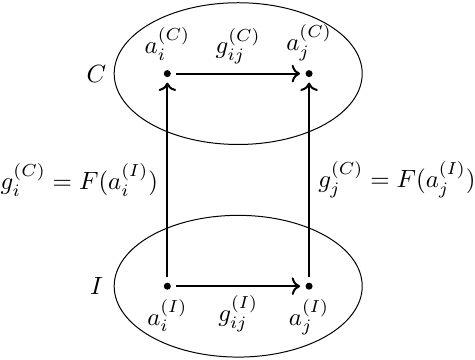
Let \(\mathbf{I}\) and \(\mathbf{C}\) are 2 categories. The diagram of shape \(\mathbf{I}\) in \(\mathbf{C}\) is a Functor (see Diagram of shape) \[F: \mathbf{I} \Rightarrow \mathbf{C}\]
Category \(\mathbf{I}\) in the Diagram of shape is called Index category.
Limit
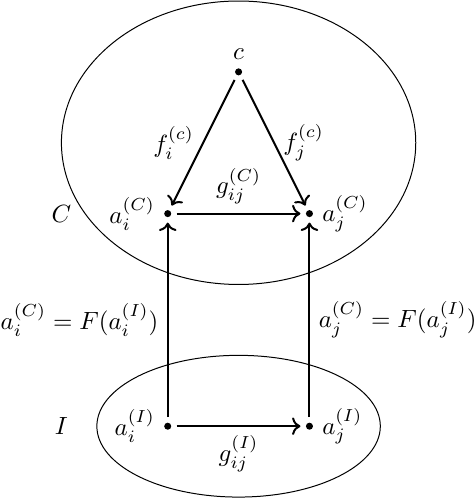
Let \(F\) be a Diagram of shape \(\mathbf{I}\) in \(\mathbf{C}\). A cone to \(F\) is an object \(c \in \mathrm{ob}(\mathbf{C})\) with Morphisms \(f^{c} = \left\{f_i^{c}: c \to a_i^{(C)}\right\}\), where \(a_i^{(C)} = F(a_i^{(I)})\) indexed by objects from \(\mathbf{I}\) (see Cone). For every \(g_{ij}^{(I)}: a_i^{(I)} \to a_j^{(I)}\) with \(g_{ij}^{(C)} = F(g_{ij}^{(I)})\) the following condition holds: \[g_{ij}^{(C)} \circ f_i^{(c)} = f_j^{(c)}.\] The cone is denoted as \(\mathrm{cone}(c, f^{(c)})\).
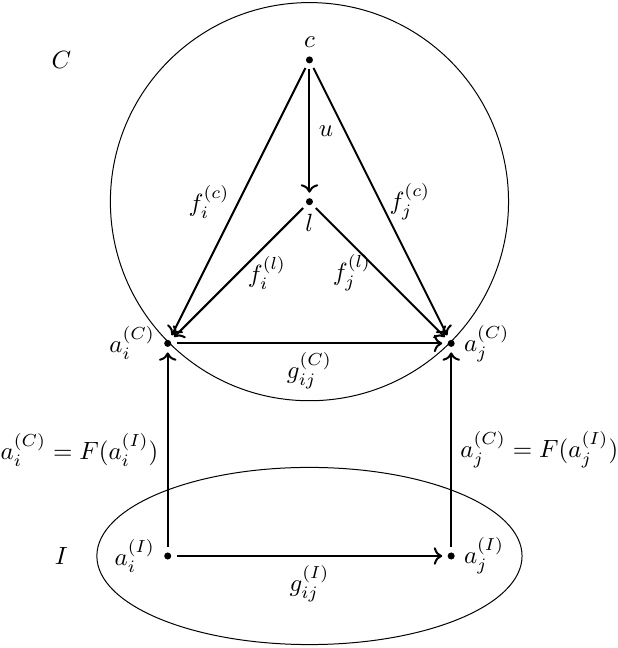
Limit of Diagram of shape \(F: \mathbf{I} \Rightarrow \mathbf{C}\) is a Cone \(\mathrm{cone}(l, f^{(l)})\) to \(F\) such that for any other \(\mathrm{cone}(c, f^{(c)})\) to \(F\) exists an unique morphism \(u : c \to l\) such that \(\forall a_i^{(I)} \in \mathrm{ob}(\mathbf{I})\) \(f_i^{(l)} \circ u = f_i^{(c)}\) i.e. diagram shown on Limit commutes.
If we have 2 objects from \(\mathbf{C}\) (\(c_1, c_2 \in \mathrm{ob}(\mathbf{C})\)) then we can have a lot of morphisms between the objects which form a set: \(\mathrm{hom}_{\mathbf{C}}\left(c_1, c_2\right)\). There is a subset of \(\mathrm{hom}_{\mathbf{C}}\left(c_1, c_2\right)\) that can be called as cone’s morphisms.
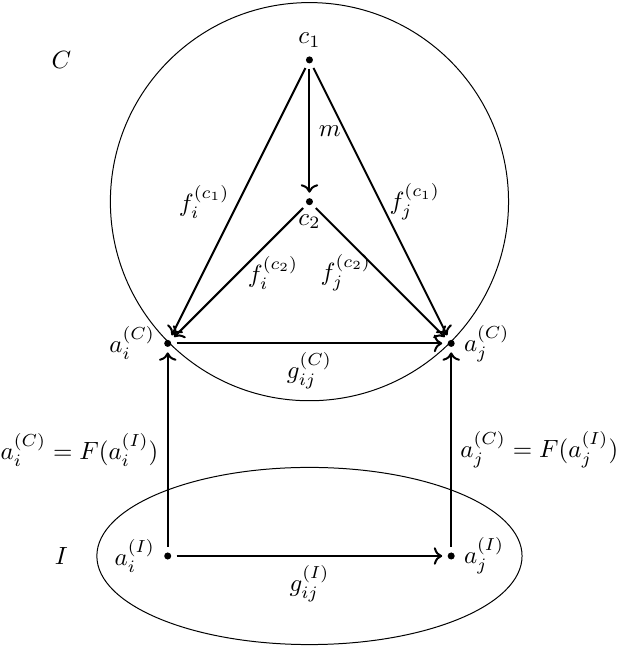
Let \(c_1, c_2 \in \mathrm{ob}(\mathbf{C})\) are 2 objects from category \(\mathbf{C}\) and \(\mathrm{cone}(c_1, f^{(c_1)}), \mathrm{cone}(c_2, f^{(c_2)})\) are 2 Cones. The morphism \(m \in \mathrm{hom}_{\mathbf{C}}\left(c_1, c_2\right)\) is called as morphism of cones if \(\forall i\) \[f_i^{(c_1)} = f_i^{(c_2)} \circ m,\] i.e. the morphisms in Morphisms of cones commute.
Let \(F\) be a Diagram of shape \(\mathbf{I}\) in \(\mathbf{C}\). The objects of the category are Cones \(\mathrm{cone}(c, f^{(c)})\) to \(F\). A morphism from \(\mathrm{cone}(c_1, f^{(c_1)})\) to \(\mathrm{cone}(c_2, f^{(c_2)})\) is a Morphism \(m: c_1 \to c_2\) in \(\mathbf{C}\) such that \(\forall i\) \[f_i^{(c_1)} = f_i^{(c_2)} \circ m.\] The identity morphism is the identity morphism of the cone’s apex, and the composition is inherited from \(\mathbf{C}\).
The category of Cones is denoted as \(\Delta \downarrow F\) (Wikipedia contributors 2018)
Let \(F\) is a Diagram of shape \(\mathbf{I}\) in \(\mathbf{C}\) and \(\Delta \downarrow F\) is the Category of cones to F. Then Limit is Terminal object in the category.
Colimit
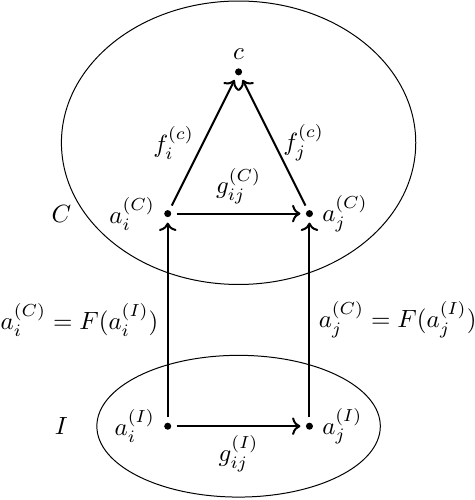
Let \(F\) be a Diagram of shape \(\mathbf{I}\) in \(\mathbf{C}\). A co-cone to \(F\) is an object \(c \in \mathrm{ob}(\mathbf{C})\) with Morphisms \(f^{c} = \left\{f_i^{c}: a_i^{(C)} \to c \right\}\), where \(a_i^{(C)} = F(a_i^{(I)})\) indexed by objects from \(\mathbf{I}\) (see Cocone). For every \(g_{ij}^{(I)}: a_i^{(I)} \to a_j^{(I)}\) with \(g_{ij}^{(C)} = F(g_{ij}^{(I)})\) the following condition holds: \[f_j^{(c)} \circ g_{ij}^{(C)} = f_i^{(c)}.\] The co-cone is denoted as \(\mathrm{cocone}(c, f^{(c)})\).
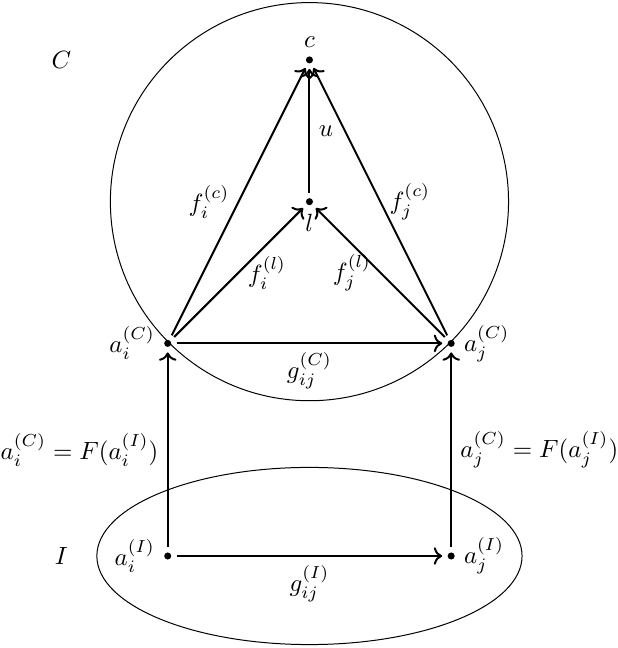
Co-Limit of Diagram of shape \(F: \mathbf{I} \Rightarrow \mathbf{C}\) is a Cocone \(\mathrm{cocone}(l, f^{(l)})\) to \(F\) such that for any other \(\mathrm{cocone}(c, f^{(c)})\) to \(F\) exists an unique morphism \(u : l \to c\) such that \(\forall a_i^{(I)} \in \mathrm{ob}(\mathbf{I})\) \(u \circ f_i^{(l)} = f_i^{(c)}\) i.e. diagram shown on Colimit commutes.
Let \(F\) be a Diagram of shape \(\mathbf{I}\) in \(\mathbf{C}\). The objects of the category are Cocones \(\mathrm{cocone}(c, f^{(c)})\) from \(F\). A morphism from \(\mathrm{cocone}(c_1, f^{(c_1)})\) to \(\mathrm{cocone}(c_2, f^{(c_2)})\) is a Morphism \(m: c_1 \to c_2\) in \(\mathbf{C}\) such that \(\forall i\) \[f_i^{(c_2)} = m \circ f_i^{(c_1)}.\] The identity morphism is the identity morphism of the co-cone’s apex, and the composition is inherited from \(\mathbf{C}\).
The category of Cocones is denoted as \(F \downarrow \Delta\) (Wikipedia contributors 2018)
Let \(F\) is a Diagram of shape \(\mathbf{I}\) in \(\mathbf{C}\) and \(F \downarrow \Delta\) is the Category of co-cones from F. Then Colimit is Initial object in the category.
Cone as natural transformation
The Cone can be considered as a Natural transformation. There are 2 functors between categories \(\mathbf{I}\) and \(\mathbf{C}\). The first one is the Diagram of shape \(F: \mathbf{I} \Rightarrow \mathbf{C}\). The second one is the Constant functor: \(\Delta_c: \mathbf{I} \Rightarrow \mathbf{C}\). The Natural transformation \(\Delta_c \xrightarrow{.} F\), by the definition, is the set of Morphisms from \(\mathbf{C}\) with additional relations that are same as conditions defined for the Cone \(\mathrm{cone}(c, f^{(c)})\). Therefore we can consider the Cone as a Natural transformation.
Categorical constructions as limits
Different choice for category \(\mathbf{I}\) gives different types of limits. There are several examples of such constructions below
The empty category will give us the terminal object. The Discrete category with 2 elements produces Product as the Limit.
Initial and terminal objects
If we choose Empty category as the Index category (see Initial and terminal objects) then we can get Terminal object as Limit and Initial object as Colimit.
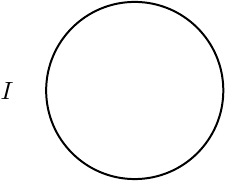
Lets choose Empty category as the Index category \(\mathbf{I}\).
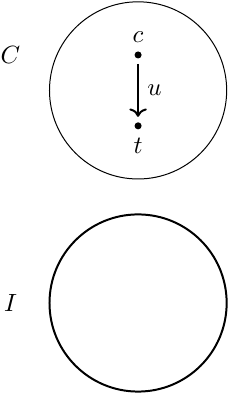
The Cone consists from the apex \(c\) only (see Limit). The Limit will be Terminal object in the category \(\mathbf{C}\).
Lets choose Empty category as the Index category \(\mathbf{I}\).
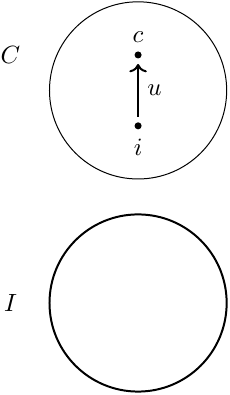
The Cocone consists from the apex \(c\) only (see Colimit). The Colimit will be Initial object in the category \(\mathbf{C}\).
Product and sum
If choose Discrete category with 2 objects as the Index category (see Product and sum) then we can get Product as Limit and Sum as Colimit.
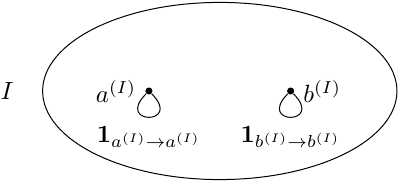
Lets choose Discrete category with 2 objects as the Index category \(\mathbf{I}\).
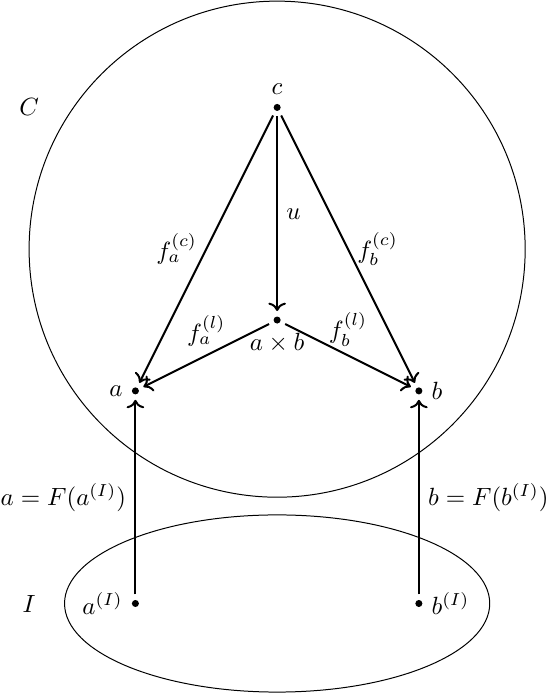
The Diagram of shape \(F\) gives us the mapping into 2 objects in the category \(\mathbf{C}\) (see Limit). The Limit of the Diagram of shape is the Product of the 2 objects in the category \(\mathbf{C}\).
Lets choose Discrete category with 2 objects as the Index category \(\mathbf{I}\).
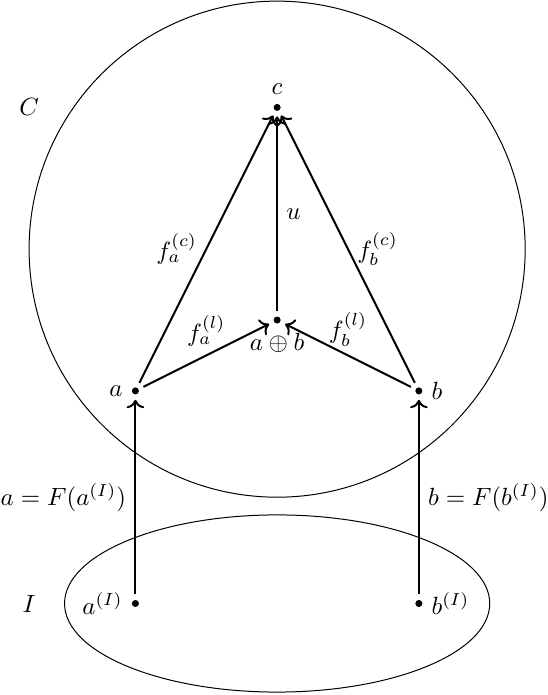
The Diagram of shape \(F\) gives us the mapping into 2 objects in the category \(\mathbf{C}\) (see Colimit). The Colimit of the Diagram of shape is the Sum of the 2 objects in the category \(\mathbf{C}\).
Equalizer
If choose a Category with 2 objects as the Index category (see Equalizer) and 2 Morphisms connecting one object with another then we can get equalizer as Limit.
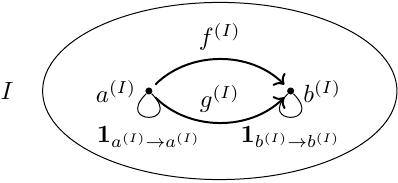
Lets choose a Category with 2 objects \(a^{(I)}, b^{(I)}\) and 2 additional morphisms \(f^{(I)}, g^{(I)} \in \mathrm{hom}_{\mathbf{I}}\left(a^{(I)}, b^{(I)}\right)\) as the Index category \(\mathbf{I}\) (see Equalizer).
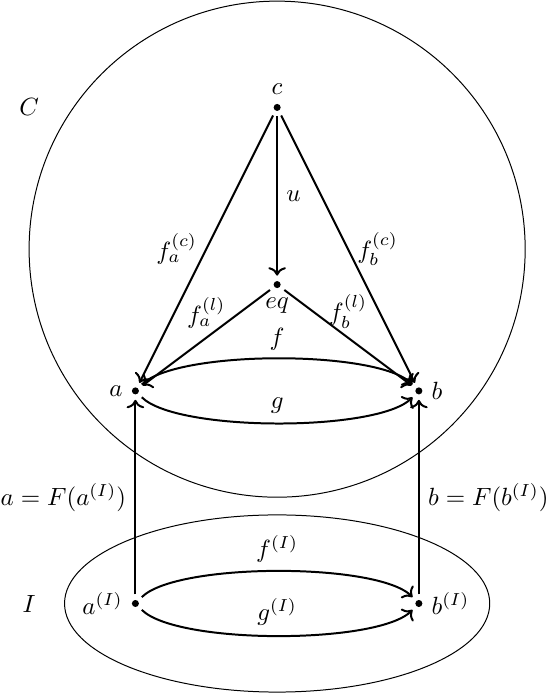
The Diagram of shape \(F\) gives us the mapping into 2 objects and 2 morphisms in the category \(\mathbf{C}\). The Limit of the Diagram of shape (see Equalizer) is the equalizer. The equalizer is denoted as \(eq\left(f, g\right)\).
The meaning of the Equalizer can be described in the Set category
In the Set category equalizer determines a solution for the following equation \[f(x) = g(x)\] Let us consider 2 Sets \(A\) and \(B\) and 2 Functions \(f, g: A \to B\). The equalizer is a subset of \(A\) that contains all elements where both functions have the same value: \[eq(f, g) = \left\{x \in A \mid f(x) = g(x)\right\}.\] The cone morphism \(f_a^{(l)}: eq(f, g) \to A\) is the inclusion map. Thus if we have any other set \(C\) and a function \(h: C \to A\) such that \(f \circ h = g \circ h\), then every value \(h(c)\) belongs to \(eq(f, g)\). Therefore there exists a unique function \(u: C \to eq(f, g)\) such that \[f_a^{(l)} \circ u = h.\] This is exactly the universal property of the Limit for the equalizer diagram.
Discussion
Register with a username and password to join the discussion.