Introduction
We will start with the classical construction and then look at the place where the quantum algorithm changes the situation. Elliptic curve cryptography uses a group of points on a curve. The public operation in this group is scalar multiplication. The private problem is inverse to it: given two points \(g\) and \(q\), find a number \(x\) such that \[x g = q.\] This problem is called the discrete logarithm problem on elliptic curves.
Classically, the problem is considered hard for well-chosen curves and subgroups. Shor’s algorithm (Shor 1994) changes the character of the problem. It replaces the direct search for \(x\) with a period finding problem, and the period can be found by a quantum Fourier transform. We will use one small curve throughout the article. The numbers are not cryptographically large, but they are convenient because every step can be written explicitly.
Elliptic Curves over the Real Numbers
In elliptic cryptography we consider sets of objects that form a group. As such a set we will use points that belong to a curve. We start with the curve over the real numbers: \[E: y^2 = x^3 + a x + b.\]
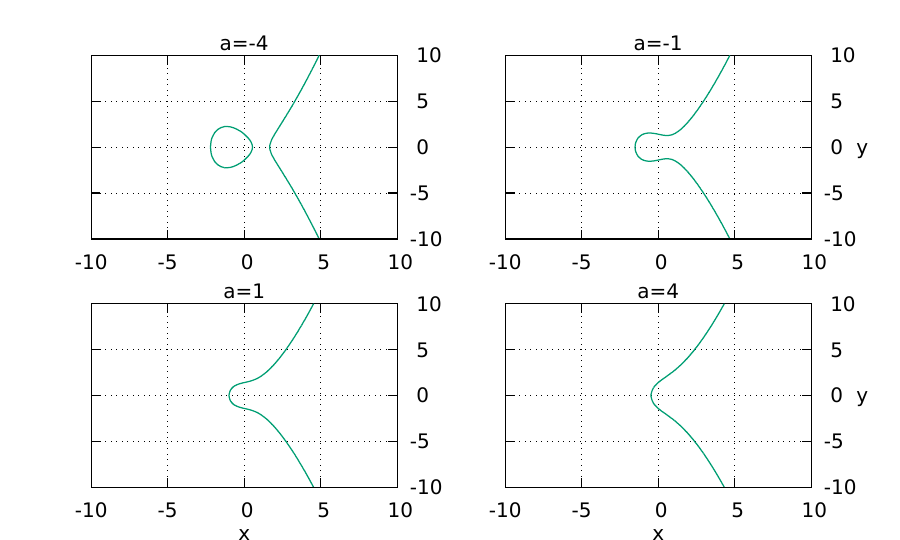
The coefficients \(a\) and \(b\) have to satisfy the condition \[4a^3 + 27b^2 \ne 0.\] This condition excludes singular curves, i.e. curves where the cubic polynomial has a multiple root (Washington 2008).
We have to define a binary operation on the points of the curve. This operation maps two points \(p\) and \(q\) to a third point \(r\): \[p + q = r.\] We will call this operation addition.
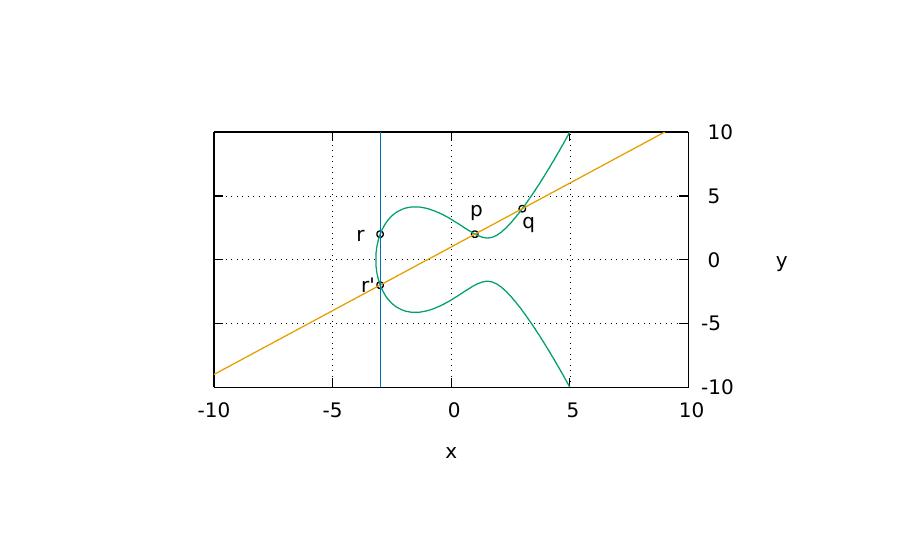
Let us describe the construction. Suppose that the points \(p\) and \(q\) have coordinates \((x_p,y_p)\) and \((x_q,y_q)\). If \(x_p \ne x_q\), then the line through these two points has slope \[m = \frac{y_p - y_q}{x_p - x_q}.\] This line intersects the cubic curve in one more point \(r'\). If the coordinates of this point are \((x_{r'},y_{r'})\), then \[y_{r'} = y_p + m(x_{r'} - x_p).\] The point \(r'\) belongs to the curve, therefore \[\left(y_p + m(x_{r'} - x_p)\right)^2 = x_{r'}^3 + a x_{r'} + b.\] After moving all terms to one side we obtain a cubic equation in \(x_{r'}\). Its three roots are \(x_p\), \(x_q\), and \(x_{r'}\). Hence the coefficient of \(x^2\) gives us \[x_{r'} + x_p + x_q = m^2.\] Thus \[x_{r'} = m^2 - x_p - x_q.\] The sum \(r=p+q\) is defined as the reflection of \(r'\) with respect to the \(X\)-axis. Therefore the final formula is \[\begin{aligned} x_r &= m^2 - x_p - x_q, \nonumber \\ y_r &= -y_p + m(x_p - x_r). \label{eq:real-addition} \end{aligned}\]
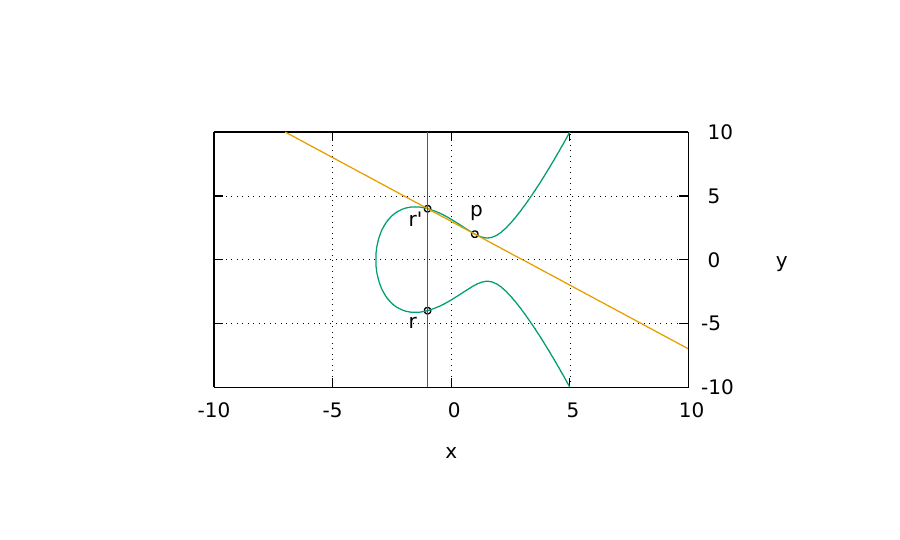
There are two special cases. First, if \(p=q\), then the line through the two points becomes the tangent line. In this case \[m = \frac{3x_p^2 + a}{2y_p}.\]
Second, if \(q=-p\), then the line is vertical. It does not produce a finite third point. For this reason we add one extra point \(0\), the point at infinity, and define \[p + (-p) = 0.\]
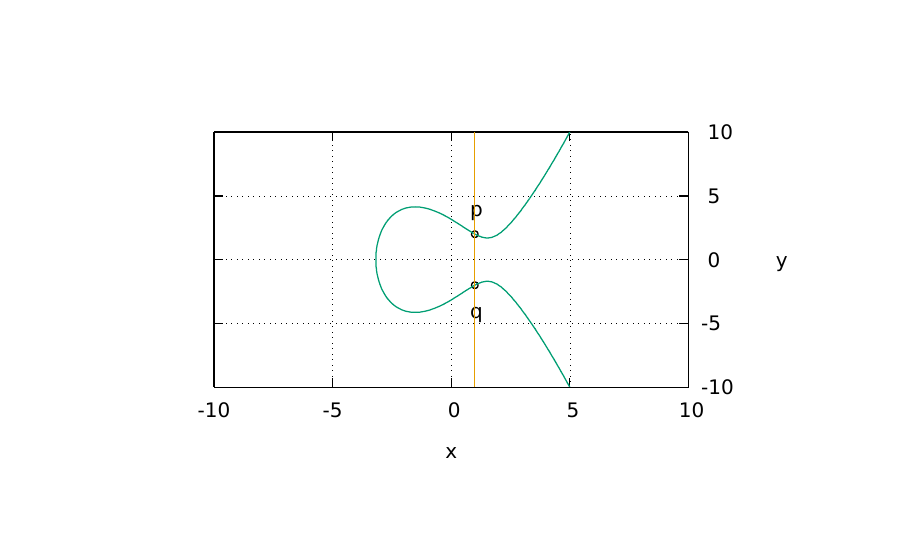
Thus the elliptic curve over the real numbers is the set \[E(\mathbb{R}) = \{(x,y)\in \mathbb{R}\times\mathbb{R}: y^2=x^3+ax+b\} \cup \{0\}.\] With the operation described above, this set forms an abelian group. The associativity of this operation is not obvious from the geometric definition, but it is a standard property of elliptic curves (Washington 2008).
Remark.
At first glance this addition looks artificial. It would be more natural to add points as vectors in the plane. But vector addition does not preserve the curve: if \(p,q\in E(\mathbb{R})\), it is usually not true that the vector sum also belongs to \(E(\mathbb{R})\). The operation above is useful because it keeps us inside the same set and therefore gives a group.
Elliptic Curves over a Finite Field
The same short Weierstrass construction can be moved from \(\mathbb{R}\) to fields whose characteristic is neither \(2\) nor \(3\). For cryptography, the important case in this article is the finite field \(\mathbb{F}_p\), where \(p>3\) is prime. We define \[E(\mathbb{F}_p) = \{(x,y)\in \mathbb{F}_p\times\mathbb{F}_p: y^2 \equiv x^3 + ax + b \pmod p\} \cup \{0\}.\] The number of points on the curve is called the order of the curve and is denoted by \(|E|\).
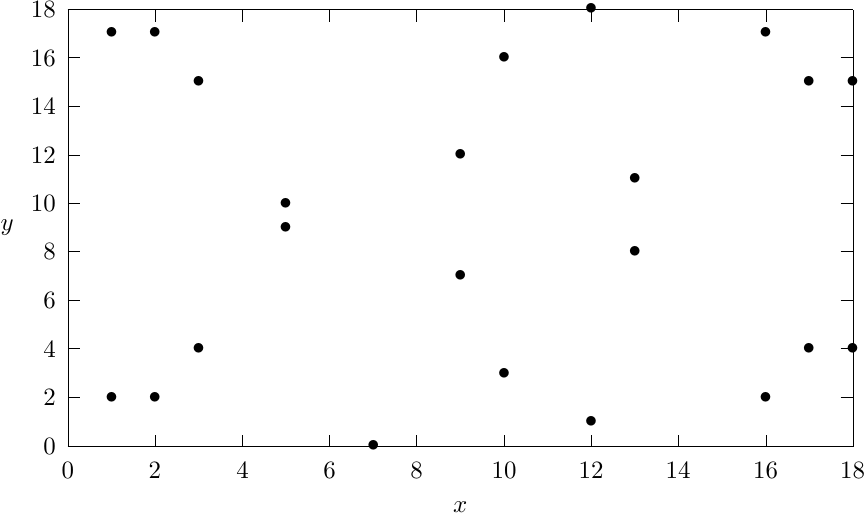
For every point \(a=(x_a,y_a)\) there is an inverse point \[-a = (x_a,-y_a \bmod p).\] The addition law has the same form as before, but all operations are taken modulo \(p\). If \(a+b=c\) and \(b\ne -a\), then \[\begin{aligned} x_c &\equiv m^2 - x_a - x_b \pmod p, \nonumber \\ y_c &\equiv -y_a + m(x_a - x_c) \pmod p. \label{eq:finite-addition} \end{aligned}\] The slope is computed as follows: \[m \equiv \begin{cases} (y_a-y_b)(x_a-x_b)^{-1} \pmod p, & x_a\ne x_b,\\ (3x_a^2+a)(2y_a)^{-1} \pmod p, & x_a=x_b. \end{cases}\] Here \(z^{-1}\) denotes the multiplicative inverse of \(z\) modulo \(p\). If \(b=-a\), then \(a+b=0\).
Scalar Multiplication and Discrete Logarithm
Let \(n\) be a natural number and let \(a\in E(\mathbb{F}_p)\). We define scalar multiplication as repeated addition: \[n\cdot a = \underbrace{a+a+\dots+a}_{n\ \mathrm{times}}.\] A direct implementation needs \(O(n)\) additions. Using the usual divide-and-conquer idea, or double-and-add, the same operation can be computed with \(O(\log n)\) additions.
Example.
Consider the curve \[E(\mathbb{F}_{19}) = \{(x,y)\in\mathbb{F}_{19}\times\mathbb{F}_{19}: y^2 \equiv x^3 - 7x + 10 \pmod {19}\}\cup\{0\}.\] Choose the point \(p=(13,8)\). Its multiples are as follows: \[\begin{array}{c|c} k & k\cdot p \\ \hline 0 & 0 \\ 1 & (13,8) \\ 2 & (16,17) \\ 3 & (18,15) \\ 4 & (12,1) \\ 5 & (5,10) \\ 6 & (7,0) \\ 7 & (5,9) \\ 8 & (12,18) \\ 9 & (18,4) \\ 10 & (16,2) \\ 11 & (13,11) \\ 12 & 0 \end{array}\] Thus \(p\) generates a cyclic subgroup of order \(12\).
As we can see from the example, each point generates some cyclic subgroup. The whole group of points on an elliptic curve does not have to be cyclic. On the other hand, the discrete logarithm construction requires a cyclic group. Therefore, for a given curve, we first compute its order. There is an efficient classical algorithm for this task, Schoof’s algorithm (Schoof 1985). Then we choose a prime divisor of the order and search for a point that generates a subgroup of this prime order.
The construction uses the following fact. For every point \(g\in E\) we have \[N g = 0,\] where \(N=|E|\) is the order of the curve. Suppose that \(n\) is a prime divisor of \(N\), so \[N = h n.\] Then \[N g = n(hg) = 0.\] If \(hg\ne 0\), then \(g'=hg\) generates a cyclic subgroup whose order is \(n\).
Remark.
It is natural to choose a subgroup of prime order. If the order of a group is prime, then by Lagrange’s theorem it has only two subgroups: the trivial subgroup and the group itself. Therefore any nonzero element of such a group is a generator.
Example.
We will use the curve \[E = E(\mathbb{F}_{97}) = \{(x,y)\in\mathbb{F}_{97}\times\mathbb{F}_{97}: y^2 \equiv x^3 - 7x + 10 \pmod {97}\}\cup\{0\}.\] The order of this curve is \[N = |E| = 82.\]
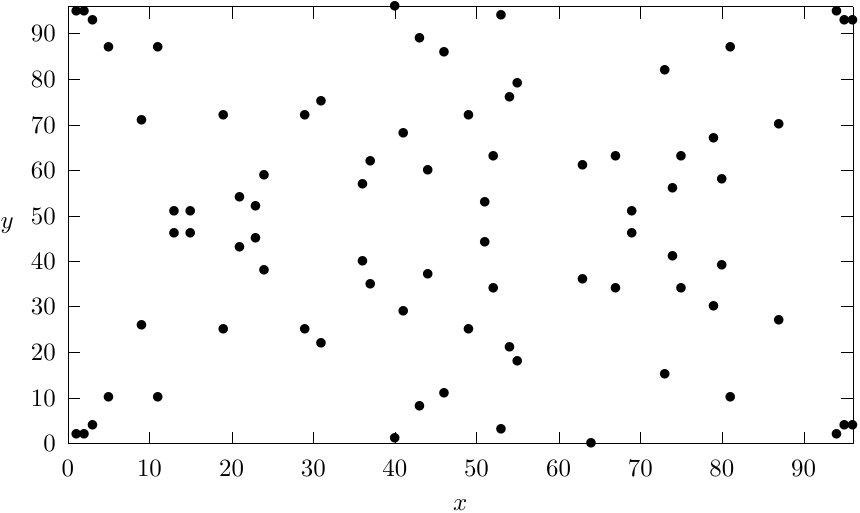
The number \(82\) has the prime divisor \(41\). Thus \(h=2\). Take \(u=(1,2)\). This point has order \(82\), not \(41\), so we project it to the prime-order subgroup by multiplying by the cofactor: \[g = h u = 2u = (96,93).\] The point \(g\) has order \(41\). This is the base point that we will use below.
Now we can state the elliptic-curve discrete logarithm problem. Given two points \(a,b\in E(\mathbb{F}_p)\), we ask whether there is a number \(x\) such that \[x\cdot a = b.\] If such a number exists, then finding it is the discrete logarithm problem on elliptic curves.
The ECDH Algorithm
The ECDH algorithm is the Diffie-Hellman key exchange moved to elliptic curves. The public parameters are \[(p,a,b,g,n,h),\] where \(p,a,b\) define the curve \[E(\mathbb{F}_p)= \{(x,y): y^2 \equiv x^3+ax+b \pmod p\}\cup\{0\},\] the point \(g\) is the base point of order \(n\), and \(h\) is the cofactor, i.e. \[|E| = nh.\]
Alice chooses a private key \[d_a\in\{1,\dots,n-1\}\] and computes the public key \[A = d_a g.\] Bob chooses a private key \(d_b\) and computes \[B = d_b g.\] After exchanging the public keys, both sides compute the same shared point: \[K = d_a B = d_a d_b g = d_b A.\] In a real protocol this point is not used directly as a symmetric key. The usual next step is to encode a fixed component of \(K\), typically its \(x\)-coordinate, and feed it into a key-derivation function.
Example.
Take the curve and the base point constructed above: \[(p,a,b,g,n,h) = (97,-7,10,(96,93),41,2).\] Alice chooses \[d_a = 5.\] Her public key is \[A = d_a g = (37,35).\] Bob chooses \[d_b = 15.\] His public key is \[B = d_b g = (15,51).\] Now Alice computes \[d_a B = (46,11),\] and Bob computes \[d_b A = (46,11).\] Thus both sides obtain the same shared point.
Shor’s Algorithm
Now let us look at the same example from the point of view of Shor’s discrete logarithm algorithm. We are given a base point \(g\) of order \(n\) and a point \(q\) in the cyclic subgroup generated by \(g\). We have to find \(x\in\mathbb{Z}/n\mathbb{Z}\) such that \[xg = q. \label{eq:elliptic-dlog}\] In the ECDH example \(q=A=(37,35)\), and the hidden number is \(x=d_a=5\).
Consider the following auxiliary function: \[f(x_1,x_2) = x_1 q + x_2 g. \label{eq:aux-function}\] Since \(q=xg\), this function can be rewritten as \[f(x_1,x_2) = (x x_1 + x_2)g.\] This is the elliptic-curve analogue of the function used in Shor’s algorithm for the ordinary discrete logarithm problem (Proos and Zalka 2003). The ordinary group version, together with the two-dimensional Fourier derivation, is described in Quantum Fourier Transform and Discrete Logarithms. Here the multiplicative group is replaced by the cyclic subgroup generated by the point \(g\).
After the function is evaluated in a quantum register, the value register is measured. Suppose that the result is a point \(c\) from the subgroup generated by \(g\). Then there is a number \(x_0\) such that \[c = x_0 g.\] The remaining pairs \((x_1,x_2)\) satisfy \[x x_1 + x_2 \equiv x_0 \pmod n.\] Thus, in the same way as in the ordinary discrete logarithm case, we can consider the function \[f'(x_1,x_2)= \begin{cases} 1, & x x_1 + x_2 \equiv x_0 \pmod n,\\ 0, & x x_1 + x_2 \not\equiv x_0 \pmod n. \end{cases} \label{eq:indicator-function}\] The Fourier image of this function contains information about the hidden number \(x\). In the idealized case the maxima identify the period relation. In a finite sampled computation we obtain approximations, but the same idea remains.
Example.
Use the ECDH public key \[A=(37,35)\] and the base point \[g=(96,93).\] We have \[f(x_1,x_2)=x_1 A+x_2 g.\] Let the measurement result be \(c=g\). Then \(x_0=1\), and the remaining pairs satisfy \[x x_1 + x_2 \equiv 1 \pmod {41}.\] For our small example the following pairs satisfy this relation: \[\begin{array}{c|c|c} x_1 & x_2 & x_1 A+x_2 g \\ \hline 0 & 1 & g \\ 7 & 7 & g \\ 8 & 2 & g \\ 15 & 8 & g \\ 16 & 3 & g \end{array}\]
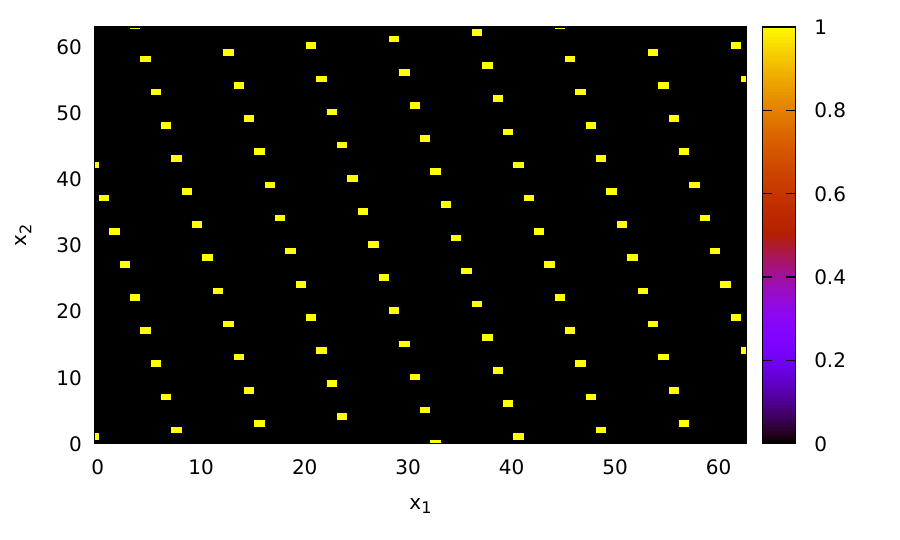
Take, for example, the pairs \((7,7)\) and \((8,2)\). Both correspond to the same measured point. Therefore \[7x+7 \equiv 8x+2 \pmod {41}.\] Subtracting the left-hand side from the right-hand side, we obtain \[x(8-7) + (2-7) \equiv 0 \pmod {41}.\] Hence \[x \equiv 5 \pmod {41}.\] This is exactly Alice’s private key from the ECDH example.
We can also use the neighboring points \((8,2)\) and \((16,3)\). Their difference is \((8,1)\), and therefore \[8x + 1 \equiv 0 \pmod {41}.\] Since \(8^{-1}\equiv 36 \pmod {41}\), we get \[x \equiv -36 \equiv 5 \pmod {41}.\]
In the original quantum algorithm, we do not inspect these pairs directly. Instead, the two-dimensional Fourier transform is applied to the register. For a sample size \(M=64\), the lower-left local maxima in this example are near \[(8,2),\quad (15,3),\quad (24,5).\]
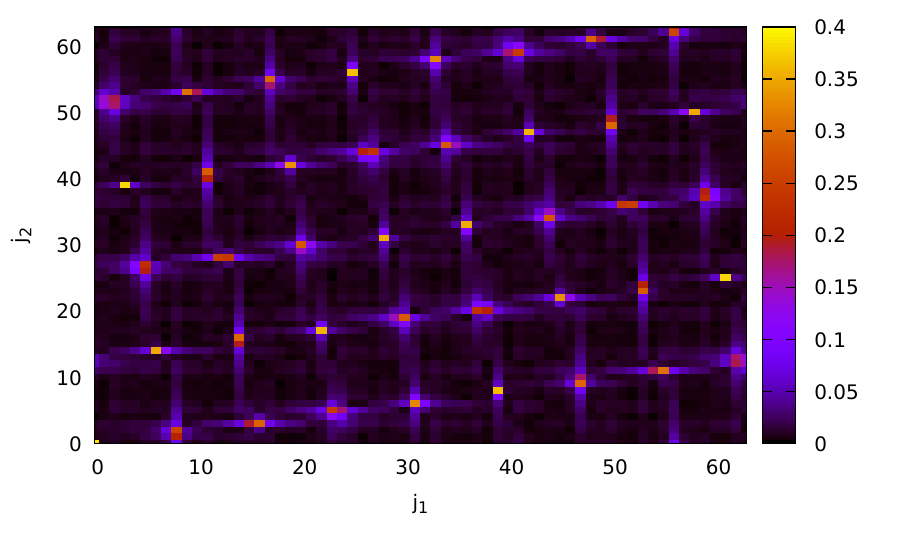
The ratios \[\frac{8}{2}=4,\qquad \frac{15}{3}=5,\qquad \frac{24}{5}=4.8\] give approximations to the hidden value \(x=5\). The first ratio is rough because the second coordinate is small, so a small displacement of the maximum changes the ratio substantially. With large parameters the same mechanism is used to recover the discrete logarithm with high probability (Nielsen and Chuang 2000).
Conclusion
The ECDH protocol hides the private number \(d_a\) inside the equation \[A=d_a g.\] Classically, recovering \(d_a\) from \(A\) and \(g\) is the elliptic curve discrete logarithm problem. Shor’s algorithm does not solve it by trying possible values of \(d_a\). Instead, it builds a function whose level sets encode the hidden linear relation \[x x_1 + x_2 \equiv x_0 \pmod n,\] and then extracts this relation by Fourier analysis. For the small curve used in the article, this relation gives \(x=5\), the private key used by Alice.
Discussion
Register with a username and password to join the discussion.